


Introduction
I was recently introduced to the apparently famous quote by William Wordsworth which reads, “Poetry is the spontaneous overflow of powerful feelings; it takes it’s origin from emotion recollected in tranquility.” To be perfectly honest, this quote first struck me as completely opposed to my approach to poetry up till now, for two main reasons. First, I did not think that poetry needed to be powered by intense emotion. Second, I felt like poetry was something that could be written within the smallest windows of opportunity, regardless of the surrounding commotion. This is evidenced by the silence of my former articles about writing poetry (see here and here if you haven’t read them) on the subject of locale and the condition of the writer, and there was only the briefest of treatments on the subject of emotions when talking about inspiration. You see now what I mean by “completely opposed”?
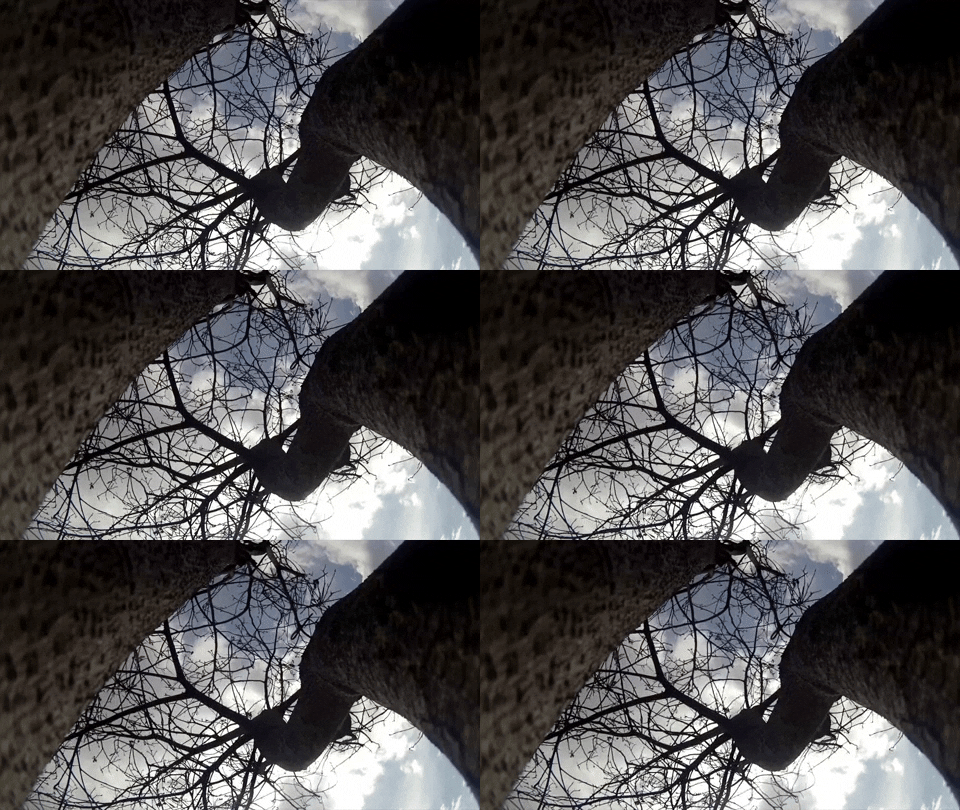
But after taking some time to review my experiences, I see that he’s right. For me, at any rate, poetry has always been one of the most effective ways of venting things that feel too big or confusing to express any other way. But I had missed this part of the puzzle, because I have a bad habit of ignoring my emotional waves, or letting them go unnamed even when they’ve taken hold of me. This habit is so ingrained that I can see something as simple as a stone lying a certain way, a tree hanging off a cliff, my cat doing something silly, or flowers in a vase, and have an emotional reaction, but the only thing that noticeably registers in my brain is “I think there’s a poem in that”, not the emotion itself, nor any name that might be associated with it. In like manner, I had not noticed the tranquility part of the equation because of other questionable quirks. Usually, once inspired, I begin immediately to write, regardless of the situation, or at least take notes, often shutting out whatever may be happening around me in the process. In other words, I can, at times, make my own tranquility, immediately disengaging from my surroundings, situation, or condition to focus on the words that will help me tap into that ephemeral “there’s a poem in this”, which is really a remembered emotion that has already come and gone. But I also know, from experience, that I write far more poems in nature (the epitome of tranquility) than anywhere else, and simply hadn’t put two and two together.
I think I mentioned this in my last article, but the importance of the Holy Spirit in the process of writing poetry as a believer should not be overlooked either. I have become convince that I could have written almost none of my poems without His express guidance, and the lessons He’d taught me before pen ever met page. Not to say my poems are God-breathed or anything, but let’s be real; nothing truly good dwells in this body of flesh. Truth comes from God and the knowledge of Him, so if there is anything truly valuable in my poems, I can’t rightfully take credit for it. Do I think I’m somehow closer to God’s spirit in nature than otherwise? No, obviously not. The Scriptures say that He dwells in me, not in the trees. But perhaps the trees put me in a mood to listen better.
So when, after hearing Wordsworth’s take on poetry and reflecting, I also happened to get a good dose of nature enjoyment, it came as no surprise to me that a poem tumbled out of me; an avalanche of emotions kept too long on ice; simmering emotions finally boiling over in a moment of stillness and remembrance. This is that poem.

A Scraggly Tree
A scraggly tree, a shameful tree
Would not in suburbs be born
It angles, it tangles, so low it dangles
If tended ‘twould surely be shorn

An aged tree, it lichenous be
A tower less green than gray
Burdened, burned, and by degrees turned
In watching the times and the days

Yet giving tree, so generously
You offer shade to us all
With rustles, and snuffles, and daring scuttles
“Find safety here!” the littles call

Growing tree, and nurturing many
Obscured by vines and mosses
A forest compressed, a fulsome nest
In love, begrudging not the losses

Whispering tree, tell all you see
For none know so well as you
Sweetly teaching, appealing, some hearts reaching
Ears lean near to honor, though few

Lonely tree, unkempt, unruly
Who will your lifeless limbs cleave?
O that young ones, heroes unsung
Brought mercy, and to your dry bark cleaved

So say I, a young one nigh
Yet to such I d’nay commit
In fear I rear, the wizened's cries unhear
Vile and blind, a fine hypocrite

Lord, make me to be more like Thee
Loving no matter the cost
By joy, restart my heart. Reveal my part
That I too may succor the lost

In Your power, Lord, my Tower
May your blessings flow abroad
To me, but more to that tree, and all the many
Who find their solace in God
Thanks for reading! I hope that this latest piece of advice opens the doors to your own poetic voice, and that, in any case, you have solace in God.
With grins,
You must be logged in to post a comment.